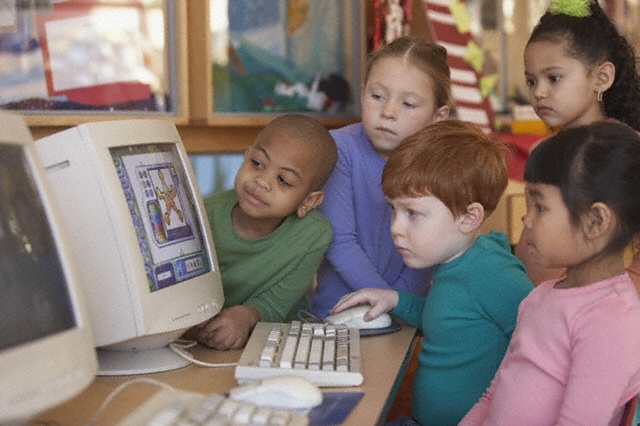
Do you remember what the first computer you had ever seen looked like, I do. It had a central processing unit that was bigger than the table it was sitting on and the monitor was bigger and wider than the television I had at my house. Before I even graduated from that elementary school, they replaced the old clunky computers with new ones. These new systems weren’t bought because the computers we had before weren’t good enough, but because they had become outdated. Sadly to say, all the schools in our area weren’t fortunate enough to be able to buy new systems for the entire school. This created a buzz around the area, and rightfully so. Since there was a gap in technology between schools, there too was a gap in education. An expert in the field of education Ron Driver explains that, “it is the system that is hurting all races and the future of all students.” This problem is happening to not only elementary schools but to all K-12 classrooms. With technology developing so quickly, it has been hard for schools to keep up with and afford technological changes happening every day. This has created a problem that continues to affect the majority of public and private schools across the globe.

The biggest problem caused by having these different technologies scattered amongst schools is that each and every child who comes out of each and every school has a different level of learned abilities in technology. The uses of Ipads, Smartboards, and advanced computers affect how students learn at higher levels. Most colleges and universities put these technologies to use. This puts an additional stress on the student who didn’t have such technologies in early education. According to Jeff McCoy, a college professor, “This creates a clear gap that continues to be broadened when students are asked to use these skills.” In addition to affecting the higher education of a student, technological lapses also become relevant in the real world. When not addressed, these skills go unnoticed and affect graduated students at their jobs.
The school systems often try to counteract ever developing technologies by recklessly throwing school funds into new systems. This causes school
budgets to be thinned out faster than ever before. Since there is no definite way to estimate how much money the school system will bring in, it’s next to impossible to gauge what can be afforded in the following fiscal year. Some schools have found that through looking into developing better technology programs, misappropriations of funds have come about. The Detroit School System is an example of this, “State education officials have ordered the emergency financial manager for Detroit Public Schools to immediately implement a plan that balances the district's books by closing half its schools”(Liepmann) directly due to financial turmoil. This causes further troubles in the school systems because some schools could have had new computer labs instead of new employee lounges. While farfetched, the
Detroit School System is an example of how the expense of technologies can put schools at risk of bankruptcy. School funding problems are happening because the greater percentages of schools don’t have the means to provide proper technology for its students.
By having schools that can afford these new systems and technologies, it creates an obvious gap to which some schools can’t compete. Inequality in advancing technology between schools needs to be solved for the simple fact that less privileged students are falling behind. Without these necessary tools in education thousands of school kids miss out on opportunities that others may have elsewhere. Not limited to the United States, students in other areas, especially areas considered technologically advanced like Japan and China are having these same problems. In order for our entire world to become a more advanced, these educational lapses need to be solved.

By not doing anything about these gaps, we are at risk of letting generations of students slip through our fingertips. Initial costs to set up these technologies make it difficult for all schools to on a level playing field. Without proper technologies students or a set standard for technologies among different schools and school systems students not only miss something that will be detrimental to their present education but also been proven to also affect real world work experience. Some teachers in the workforce today have addressed such a problem, “Although more classrooms are being equipped as smart classrooms, frequently faculty do not feel adequately prepared to teach in these classrooms incorporating some of the newer technologies” (Thoms). If this unstable, fluctuating education continues to happen then we run the risk of having long term detrimental effects. Early education continues to be essential in our society; by implanting good technologies in schools we can create a better learning atmosphere and get students better prepared for new technologies. A continuation of how schools operate now means that the student that misses out on this technology may have just been the next Steve Jobs or Bill Gates but because one school lacks technological resources, we will never know.

Technological problems among schools globally can be solved by implementing a funding baseline for all schools to meet. The goal is to create a level playing field. No schools will have more advanced technologies than the other. This established a clear line of what is expected of graduating students. This can be done by setting up specific funds for schools totally directed towards technology expenses. Having the same amount of funds to purchase technologies with is a good idea because then no one school will be superior to the other. Furthermore, school systems can be helped by providing more government funded grants. The only other way to raise money would be raising taxes. Implementing new taxes could be bothersome because people feel we already are currently taxed in excess. With government budgets already strained, it may be difficult to persuade to majority into passing votes in congress. For this plan to be successful this government funding will provide school systems with corporate sponsorships. IBM, a leader manufacturer in technologies says, “Improving public schools is its top social priority and a strategic business investment”. Having this relationship will help schools get the inexpensive yet most advanced technology to be placed in the classroom.
Past President of the United States John F. Kennedy stated that “A child miseducated is a child lost”. This holds true today, in order for our society to benefit from education we must provide equal opportunities to the masses. Technology can be better provided in schools systems by using grants and corporate sponsorships. These grants eliminate initial costs of machines, maintenance costs, and create a standard for all school budgets. This positive influence benefits society as a whole by creating a more prepared workforce for tomorrow.